(from here)
Showing posts with label economics. Show all posts
My thoughts on the AIG bonuses
The yahoos in the AIG Financial Products division who helped destroy the world's financial sector got big bonuses. Here are my thoughts on the mess:

(from here)
(from here)
Bail out Detroit
My thinking on why Congress should bail out Detroit's big 3 auto makers:
1. The consequences of not bailing them out would be disastrous and probably more expensive than a bailout. Normally this would be a disaster that could be managed with unemployment insurance, with new companies expanding to fill the gap and hiring workers, etc. But this isn't a normal time.
2. It will function as a stimulus. Beyond the non-failure of 3 giant companies along with not losing millions of jobs obviously be a good thing, but maybe even the increase in economic security after a bailout would spur consumer spending. People delaying purchases right now because they don't know whether they'll be fired because of an industry collapse might have enough trust to spend money if a bailout comes through. If 10% of US jobs really depend on the auto industry like Michigan Governor Granholm says, then this could actually be a big impact.
3. Chapter 11 bankruptcy doesn't really seem to be an option right now. Reorganization of giant companies require giant amounts of credit. That credit is currently unavailable. So if you let GM and the rest go bankrupt, it looks like they'd just shut down and nothing would replace them.
6. They deserve it more than Wall St. They make stuff, which is important. Wall Street doesn't make stuff and they are thus less important. This will obviously require some explaning:
1. The consequences of not bailing them out would be disastrous and probably more expensive than a bailout. Normally this would be a disaster that could be managed with unemployment insurance, with new companies expanding to fill the gap and hiring workers, etc. But this isn't a normal time.
2. It will function as a stimulus. Beyond the non-failure of 3 giant companies along with not losing millions of jobs obviously be a good thing, but maybe even the increase in economic security after a bailout would spur consumer spending. People delaying purchases right now because they don't know whether they'll be fired because of an industry collapse might have enough trust to spend money if a bailout comes through. If 10% of US jobs really depend on the auto industry like Michigan Governor Granholm says, then this could actually be a big impact.
3. Chapter 11 bankruptcy doesn't really seem to be an option right now. Reorganization of giant companies require giant amounts of credit. That credit is currently unavailable. So if you let GM and the rest go bankrupt, it looks like they'd just shut down and nothing would replace them.
4. I don't see any reason why American auto makers can't be profitable again if you take away the legacy health care costs (via universal health care) and replace management (untrained monkeys with dart boards would be an increase in decision quality over the current idiots). It's obvious that labor costs themselves aren't the problem - unions are much stronger in Germany than in the US, and VW, BMW and Mercedes are doing fine.
5. There isn't much of a moral hazard problem, especially with CEOs having their pay cut to $1 a year.
6. They deserve it more than Wall St. They make stuff, which is important. Wall Street doesn't make stuff and they are thus less important. This will obviously require some explaning:
Wall Street created imaginary wealth with financial instruments too complicated for anyone to understand (that was the whole point), and when the whole thing blew up they got $700 billion to try to rebuild a fantasy land. The way I understand it, we need financial institutions for two things: lending and speculation. Lending to provide capital to businesses, and speculation to even out prices. But creating financial instruments so complicated that nobody understands what they are based on isn't speculation, because nobody knows what they are betting on. Information, key in any transaction, isn't there. Then you just get a situation where people buy these things because they think other people will buy them in the future, which creates a bubble underlied by something that nobody knows what it is.
This is the reasoning that tells me that most of what got Wall Street into trouble was useless activity in the first place. Creating super-complicated financial instruments seems like a good way to take money from silly rich people and give it to smart rich people, but it doesn't do anything to grow the economy (via lending to businesses that actually produce things) or stabilize the economy (via speculation).
On top of this, Wall Street steals all the smart people that were urgently needed in Detroit board rooms.
So if Wall Street was judged important enough for a $700 billion bailout for basically adding nothing of value to the economy, shouldn't Detroit autmakers get $701 billion for adding something to the economy (even if that something is mediocre cars)?
Ultimately I think Detroit will get a bailout, but not for any of these reasons. They'll get a bailout because the Democrats control Congress and there would be hell to pay if they didn't back up the Midwest unions. Hopefully all the necessary provisions will be attached - firing management and putting some monkeys with dart boards and typewriters in charge instead, and pushing them towards a 'green' economy.
Hey look! It's politics & soccer!
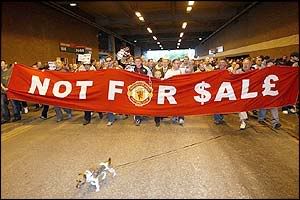
A reader* wrote in with the suggestion that I post something about the U.S. government's takeover of AIG, since AIG sponsors Manchester United. I originally didn't want to because I don't really understand the whole AIG/giant economic meltdown. But Kevin Drum doesn't understand soccer and still posted on it, so I suppose I will write something. Here it is:
HA HA HA HA HA.
A lot of Manchester United fans were actually boycotting their club after it was bought by an American, Malcolm Glazer (owner of the Tampa Bay Buccaneers and from Rochester NY!). Fans didn't only boycott because Glazer's an American, but also because he's (supposedly) a soulless businessman and bought Man Utd by giving them $850 million in debt (via financial hijinks that I also don't understand). Perhaps the debt argument stands, but these Manchester United fans weren't protesting in 1991 back when Man Utd was put on the market and thus became "for sale", only when it was bought by an American. However, now not only is their club owned by an American, but their jersey sponsor is owned by the United States government! Suckers.
*I won't lie, it was my mom, but my blog sounds more important if I pretend people read it who aren't obligated to.
HA HA HA HA HA.
A lot of Manchester United fans were actually boycotting their club after it was bought by an American, Malcolm Glazer (owner of the Tampa Bay Buccaneers and from Rochester NY!). Fans didn't only boycott because Glazer's an American, but also because he's (supposedly) a soulless businessman and bought Man Utd by giving them $850 million in debt (via financial hijinks that I also don't understand). Perhaps the debt argument stands, but these Manchester United fans weren't protesting in 1991 back when Man Utd was put on the market and thus became "for sale", only when it was bought by an American. However, now not only is their club owned by an American, but their jersey sponsor is owned by the United States government! Suckers.
*I won't lie, it was my mom, but my blog sounds more important if I pretend people read it who aren't obligated to.
Market Meltdown averted...for the time being. NASDAQ enters Bear Market.
Here is the promised post from new author Christian Flanders!
I apologize for the sensationalist title but it seems only fitting. With the DOW Futures down around 550 points overnight and overseas markets down 5 to 12% around the world, it looked like we were heading into the worst one day drop since 9/11. I was sitting at my desk around 8am when over the squawk box news of a surprise 75 point basis cut from the Fed caused a momentary spurt in future prices only to see them settle back to their levels of around -500.
However, the open was a different story. After a sharp gap down, the markets rallied throughout the day and finished *only* down 1.5%. That is still quite a bit, but compared to the indication at the open, a 4.5% drop (500 points) the markets escaped relatively unscathed. If the DOW had sold off to the equivalent levels of the asian markets, we could have easily seen a 1200+ drop. (In comparison, Japan had sold off 5% on monday then 8% on tuesday). Interday the NASDAQ did drop to the 20% from its peak level signaling the onset of a bear market. The DOW and S&P did not technically enter bear markets.
We now have a "bottom/support" at the ~11600 level approximately where the DOW opened today. Should the level crack anytime in the future, be prepared for prices to drop significantly from there.
The thing that is scary to me and probably a good indicator of how bad it is in the financial markets was that Ben Bernanke and the fed felt compelled to cut rates by 75 basis points with just 7 days to go until their scheduled meeting. The last time they cut rates 75 points between meetings was in 1985. The next few days will let us know if we have put in a short term bottom or if we will break the 11,600 mark on the DOW. Apple beat earnings after market hours but lowered their guidance. The stock has taken a hit down 10% after markets and the rest of the tech heavy nasdaq is down 1% as well in sympathy. Who would have thought that people would be unwilling to buy $400 gadgets and $2000 laptops in a recession!? Outrageous.
This rate cut only delays the inevitable. The amount of excess in the last couple years fueled by cheap money that was pumped into real estate coupled with the tremendous amount of debt we have as a nation must sooner or later be accounted for.
While we're on the topic of real estate I'm sure many of you have heard about the real estate in Manhattan. How it is so strong and will escape the wrath of the real estate bubble. You've probably heard lines like "Manhattan real estate is so strong, it always goes up." or perhaps "It's an island therefore there is a limited amount of space (scarcity) so prices will always go up, there is never a bad time to buy."
Well folks, that is the kind of talk is characteristic of a bubble. It sounds very familiar to the talk at the top of the NASDAQ in 2000. JDSU, AKAM, AMZN, EBAY, CSCO, MSFT, can't go down! All of those stocks are still dramatically below their highs set in 2000. For whatever reason, we have very limited and selective memories. Real estate brokers have either forgotten or were not brokers during the real estate recession in the late 1980's that trimmed 20 to 50% off the real estate prices in NYC.
Here is a link to a fascinating article about it: http://www.njrereport.com/80sbubble.htm
Enjoy!
I apologize for the sensationalist title but it seems only fitting. With the DOW Futures down around 550 points overnight and overseas markets down 5 to 12% around the world, it looked like we were heading into the worst one day drop since 9/11. I was sitting at my desk around 8am when over the squawk box news of a surprise 75 point basis cut from the Fed caused a momentary spurt in future prices only to see them settle back to their levels of around -500.
However, the open was a different story. After a sharp gap down, the markets rallied throughout the day and finished *only* down 1.5%. That is still quite a bit, but compared to the indication at the open, a 4.5% drop (500 points) the markets escaped relatively unscathed. If the DOW had sold off to the equivalent levels of the asian markets, we could have easily seen a 1200+ drop. (In comparison, Japan had sold off 5% on monday then 8% on tuesday). Interday the NASDAQ did drop to the 20% from its peak level signaling the onset of a bear market. The DOW and S&P did not technically enter bear markets.
We now have a "bottom/support" at the ~11600 level approximately where the DOW opened today. Should the level crack anytime in the future, be prepared for prices to drop significantly from there.
The thing that is scary to me and probably a good indicator of how bad it is in the financial markets was that Ben Bernanke and the fed felt compelled to cut rates by 75 basis points with just 7 days to go until their scheduled meeting. The last time they cut rates 75 points between meetings was in 1985. The next few days will let us know if we have put in a short term bottom or if we will break the 11,600 mark on the DOW. Apple beat earnings after market hours but lowered their guidance. The stock has taken a hit down 10% after markets and the rest of the tech heavy nasdaq is down 1% as well in sympathy. Who would have thought that people would be unwilling to buy $400 gadgets and $2000 laptops in a recession!? Outrageous.
This rate cut only delays the inevitable. The amount of excess in the last couple years fueled by cheap money that was pumped into real estate coupled with the tremendous amount of debt we have as a nation must sooner or later be accounted for.
While we're on the topic of real estate I'm sure many of you have heard about the real estate in Manhattan. How it is so strong and will escape the wrath of the real estate bubble. You've probably heard lines like "Manhattan real estate is so strong, it always goes up." or perhaps "It's an island therefore there is a limited amount of space (scarcity) so prices will always go up, there is never a bad time to buy."
Well folks, that is the kind of talk is characteristic of a bubble. It sounds very familiar to the talk at the top of the NASDAQ in 2000. JDSU, AKAM, AMZN, EBAY, CSCO, MSFT, can't go down! All of those stocks are still dramatically below their highs set in 2000. For whatever reason, we have very limited and selective memories. Real estate brokers have either forgotten or were not brokers during the real estate recession in the late 1980's that trimmed 20 to 50% off the real estate prices in NYC.
Here is a link to a fascinating article about it: http://www.njrereport.com/80sbubble.htm
Enjoy!
Africa links
Following up on my mobile banking and African development posts from earlier this week, here are some more links on development in Africa:
Geekcorps. As CurrentConductor pointed out, I probably should have mentioned them in the original post.
Africabeat - How to invest in Africa. Some excellent comments.
AfricanLoft - The 2nd Edition of Africa Enterprising Blog Carnival Opens. Links to a lot of different blogs on "Trade Vs Aid", "Entrepreneurship", "Business and Investment", etc.
beninmwangi - Zambian Head of State Joins Africa's Trade -vs- Aid Debate. Key quotations:
Geekcorps. As CurrentConductor pointed out, I probably should have mentioned them in the original post.
Africabeat - How to invest in Africa. Some excellent comments.
AfricanLoft - The 2nd Edition of Africa Enterprising Blog Carnival Opens. Links to a lot of different blogs on "Trade Vs Aid", "Entrepreneurship", "Business and Investment", etc.
beninmwangi - Zambian Head of State Joins Africa's Trade -vs- Aid Debate. Key quotations:
...it is investment and not aid that will bring about sustainable growth and development in our economies. This is not to say that aid is not important, as it does help bring about the requisite conditions for growth.Human Security Review - Bono's Africa, A Case Study. Chris Albon, a PhD student at UC-Davis, has a humorous take on a recent UNICEF ad campaign.
My government applauds China’s opening up of her markets to 28 African countries...
...leaders of African countries need to do more in the area of infrastructure development.
Mobile phone banking and poverty, part 2
Part 1 available here.
In the Washington Post, Uzodinma Iweala argues that all the attention on "saving" Africa from starvation, poverty, disease, warfare, etc., is based on Westerners' need to feel good about themselves rather than any good they will actually be doing - a new version of the "white man's burden." The way I see it, there are several problems with Western aid:
1) It fosters dependence - elites in African and other third-world countries become accountable to the sources of Western aid, rather than their own citizens/subjects;
2) It is non-scalable - if $100 feeds 100 people, $200 will feed 200 people, as opposed to a scalable system in which $100 would feed 100 people, but $200 would feed 5000 people;
3) It can be used as a weapon - both the threat of its withdrawal and selecting who receives aid can, while portrayed as benevolent aid to Western audiences, be used for less benevolent purposes;
4) It is vulnerable to corruption - some aid will inevitably be siphoned off the top;
5) Blowback - Giving aid to dictators, while sometimes in the best humanitarian interest, can have negative blowback if a Western regime is seen as supporting an undeserving government.
Instead of dumping millions of dollars on the African continent in programs with marginal impact, shouldn't we concentrate our dollars on helping locals build platforms and infrastructure? It is similar to the old saying, "Give someone a fish, they'll eat for a day, teach someone to fish, they'll eat for a lifetime." Traditional aid doesn't seem to be building up any capabilities in African states because we are just handing them fish. Contrast that to USAID's facilitation of a local company building a successful mobile banking network in the Philippines that helps both the business and the customers who pay a marginal fee to get previously unaccessible services.
While it is true that people aren't able to use economic infrastructure if they are busy dying of dysentery from unsafe drinking water, it seems to me that
a) Africans can get their own drinking water (the point of Iweala's op-ed and of James Shikwati in the interview linked above), and
b) the Live Aid people and Bono aren't stopping to ask what their money and effort is accomplishing, and whether or not they might accomplish more in other ways.
If I had fifty million bucks in aid for Africa, I'd invest it in building mobile banking platforms. It would:
1) NOT foster dependence, as it would instead help achieve economic empowerment for customers;
2) be non-scalable, as after the initial investment and annual upkeep, the growth potential is really limited only to the number of people who can afford mobile phones (which in Africa is exploding);
3) be difficult to weaponize, as it would be open-access (I suppose it'd be theoretically possible to restrict access to certain classes via a minimum deposit, but that would be bad business and I'd be in this to make money!);
4) be difficult to corrupt, as its a piece of infrastructure, rather than a heap of cash;
5) Would only get blowback from LiveAid people who chastise me for making money off of Africa.
In conclusion, I'll contrast the two ways of helping Africa. The LiveAid/Bono view sees William Kamkwamba and sees a tragedy (the guy had to drop out of school). The Iweala/Shikwati view sees a massive business opportunity, money to be made, with the betterment of local society developing as a natural consequence.
My thoughts on this are embryonic, feedback is encouraged.
In the Washington Post, Uzodinma Iweala argues that all the attention on "saving" Africa from starvation, poverty, disease, warfare, etc., is based on Westerners' need to feel good about themselves rather than any good they will actually be doing - a new version of the "white man's burden." The way I see it, there are several problems with Western aid:
1) It fosters dependence - elites in African and other third-world countries become accountable to the sources of Western aid, rather than their own citizens/subjects;
2) It is non-scalable - if $100 feeds 100 people, $200 will feed 200 people, as opposed to a scalable system in which $100 would feed 100 people, but $200 would feed 5000 people;
3) It can be used as a weapon - both the threat of its withdrawal and selecting who receives aid can, while portrayed as benevolent aid to Western audiences, be used for less benevolent purposes;
4) It is vulnerable to corruption - some aid will inevitably be siphoned off the top;
5) Blowback - Giving aid to dictators, while sometimes in the best humanitarian interest, can have negative blowback if a Western regime is seen as supporting an undeserving government.
Instead of dumping millions of dollars on the African continent in programs with marginal impact, shouldn't we concentrate our dollars on helping locals build platforms and infrastructure? It is similar to the old saying, "Give someone a fish, they'll eat for a day, teach someone to fish, they'll eat for a lifetime." Traditional aid doesn't seem to be building up any capabilities in African states because we are just handing them fish. Contrast that to USAID's facilitation of a local company building a successful mobile banking network in the Philippines that helps both the business and the customers who pay a marginal fee to get previously unaccessible services.
While it is true that people aren't able to use economic infrastructure if they are busy dying of dysentery from unsafe drinking water, it seems to me that
a) Africans can get their own drinking water (the point of Iweala's op-ed and of James Shikwati in the interview linked above), and
b) the Live Aid people and Bono aren't stopping to ask what their money and effort is accomplishing, and whether or not they might accomplish more in other ways.
If I had fifty million bucks in aid for Africa, I'd invest it in building mobile banking platforms. It would:
1) NOT foster dependence, as it would instead help achieve economic empowerment for customers;
2) be non-scalable, as after the initial investment and annual upkeep, the growth potential is really limited only to the number of people who can afford mobile phones (which in Africa is exploding);
3) be difficult to weaponize, as it would be open-access (I suppose it'd be theoretically possible to restrict access to certain classes via a minimum deposit, but that would be bad business and I'd be in this to make money!);
4) be difficult to corrupt, as its a piece of infrastructure, rather than a heap of cash;
5) Would only get blowback from LiveAid people who chastise me for making money off of Africa.
In conclusion, I'll contrast the two ways of helping Africa. The LiveAid/Bono view sees William Kamkwamba and sees a tragedy (the guy had to drop out of school). The Iweala/Shikwati view sees a massive business opportunity, money to be made, with the betterment of local society developing as a natural consequence.
My thoughts on this are embryonic, feedback is encouraged.
Mobile banking and poverty, part 1
Update: Part 2 available here.
A friend sent me this article on mobile phone banking about a week ago - it reminded me of a post I intended to do months ago but never got around to. So mobile phone banking was already in my head when I saw Uzodinma Iweala's article, "Stop Trying to 'Save' Africa," in today's Washington Post.
First, since the idea of mobile phone banking probably needs some introduction, I'll go over the story of how I stumbled across the idea.
Last year I did an internship in a government agency (Not CIA or DoD or anything, one of the "boring" ones) in their Iraq section. One of the guys told me "if you have an idea, out with it - when we're dealing with Iraq, any idea is a good idea."
One problem in Iraq that astounded me was that about a quarter of the Iraqi Army was on leave at any given time. The reason behind this was that Iraq had no national financial infrastructure, so Iraqi soldiers had to travel in person back home to deliver their paychecks - bags of cash - to their families. However, Iraq does have a mobile phone infrastructure, which by its nature is difficult to take down by insurgents - it has no obvious systempunkts, because calls can be re-routed fairly easily. So why not use the mobile phone infrastructure for basic financial transactions, such as paying the Iraqi Army? I had the idea in the back of my head after hearing it somewhere, possibly from Ethan Zuckerman's blog.
This is the idea in a nutshell:
1) Iraq has little/no national banking infrastructure
2) Lack of banking infrastructure impedes performance of economy, security forces, etc.
3) Building a brick and mortar banking infrastructure is very difficult in an insecure environment
4) Solution – build a virtual banking system using existing infrastructure (mobile phone infrastructure, SMS technology)
The concept is not new - I did some research and found two fascinating success stories - the Philippines and South Africa. In the Philippines, USAID helped Globe Telecom set up G-Cash, which uses SMS text messages to send virtual cash between phones, redeemable at ATMs and participating businesses. G-Cash competes with Smart mobile, which has their own mobile banking program. In South Africa, the WIZZIT bank links a debit card to a cell phone account, also using SMS text messages to send and receive money. And more banks or cellphone companies are springing up all the time offering similar services, most recently, Kenya's M-Pesa service. This idea has promise.
After a bunch of meetings with people from Commerce, State, Treasury, the Pentagon, etc., my internship ended, and as far as I can tell the idea went nowhere in the US government. There were a lot of little small problems with the idea (like making sure the program would be legal under Iraqi law, setting up monitoring systems to watch for money laundering, Iraqi trust in the system after Saddam abused the banking system, physical security for transfer points between virtual and physical cash, etc.). Given that I was but a lowly intern, in hindsight the idea of using a mobile-phone-based money transfer system for the Iraqi Army's payroll never had much of a chance of success. However, one American company, Security Financial Services, Inc., run by Iraqi emigres, was thinking of setting up the system - it would piggy-back on their AMAN debit card (background) . They installed 3000 debit-card readers at various points of sale, and their debit card went live back in 2006 or early 2007. From their website, it looks like they are linking their debit card to mobile phones, just like WIZZIT bank. Here is their website, and here's the website of their AMAN card.
Check out Ethan Zuckerman's blog for more on mobile phone banking, especially in Africa.
In part 2 of this post, I will link mobile phone banking to Iweala's article in the Post.
A friend sent me this article on mobile phone banking about a week ago - it reminded me of a post I intended to do months ago but never got around to. So mobile phone banking was already in my head when I saw Uzodinma Iweala's article, "Stop Trying to 'Save' Africa," in today's Washington Post.
First, since the idea of mobile phone banking probably needs some introduction, I'll go over the story of how I stumbled across the idea.
Last year I did an internship in a government agency (Not CIA or DoD or anything, one of the "boring" ones) in their Iraq section. One of the guys told me "if you have an idea, out with it - when we're dealing with Iraq, any idea is a good idea."
One problem in Iraq that astounded me was that about a quarter of the Iraqi Army was on leave at any given time. The reason behind this was that Iraq had no national financial infrastructure, so Iraqi soldiers had to travel in person back home to deliver their paychecks - bags of cash - to their families. However, Iraq does have a mobile phone infrastructure, which by its nature is difficult to take down by insurgents - it has no obvious systempunkts, because calls can be re-routed fairly easily. So why not use the mobile phone infrastructure for basic financial transactions, such as paying the Iraqi Army? I had the idea in the back of my head after hearing it somewhere, possibly from Ethan Zuckerman's blog.
This is the idea in a nutshell:
1) Iraq has little/no national banking infrastructure
2) Lack of banking infrastructure impedes performance of economy, security forces, etc.
3) Building a brick and mortar banking infrastructure is very difficult in an insecure environment
4) Solution – build a virtual banking system using existing infrastructure (mobile phone infrastructure, SMS technology)
The concept is not new - I did some research and found two fascinating success stories - the Philippines and South Africa. In the Philippines, USAID helped Globe Telecom set up G-Cash, which uses SMS text messages to send virtual cash between phones, redeemable at ATMs and participating businesses. G-Cash competes with Smart mobile, which has their own mobile banking program. In South Africa, the WIZZIT bank links a debit card to a cell phone account, also using SMS text messages to send and receive money. And more banks or cellphone companies are springing up all the time offering similar services, most recently, Kenya's M-Pesa service. This idea has promise.
After a bunch of meetings with people from Commerce, State, Treasury, the Pentagon, etc., my internship ended, and as far as I can tell the idea went nowhere in the US government. There were a lot of little small problems with the idea (like making sure the program would be legal under Iraqi law, setting up monitoring systems to watch for money laundering, Iraqi trust in the system after Saddam abused the banking system, physical security for transfer points between virtual and physical cash, etc.). Given that I was but a lowly intern, in hindsight the idea of using a mobile-phone-based money transfer system for the Iraqi Army's payroll never had much of a chance of success. However, one American company, Security Financial Services, Inc., run by Iraqi emigres, was thinking of setting up the system - it would piggy-back on their AMAN debit card (background) . They installed 3000 debit-card readers at various points of sale, and their debit card went live back in 2006 or early 2007. From their website, it looks like they are linking their debit card to mobile phones, just like WIZZIT bank. Here is their website, and here's the website of their AMAN card.
Check out Ethan Zuckerman's blog for more on mobile phone banking, especially in Africa.
In part 2 of this post, I will link mobile phone banking to Iweala's article in the Post.
Subscribe to:
Posts (Atom)